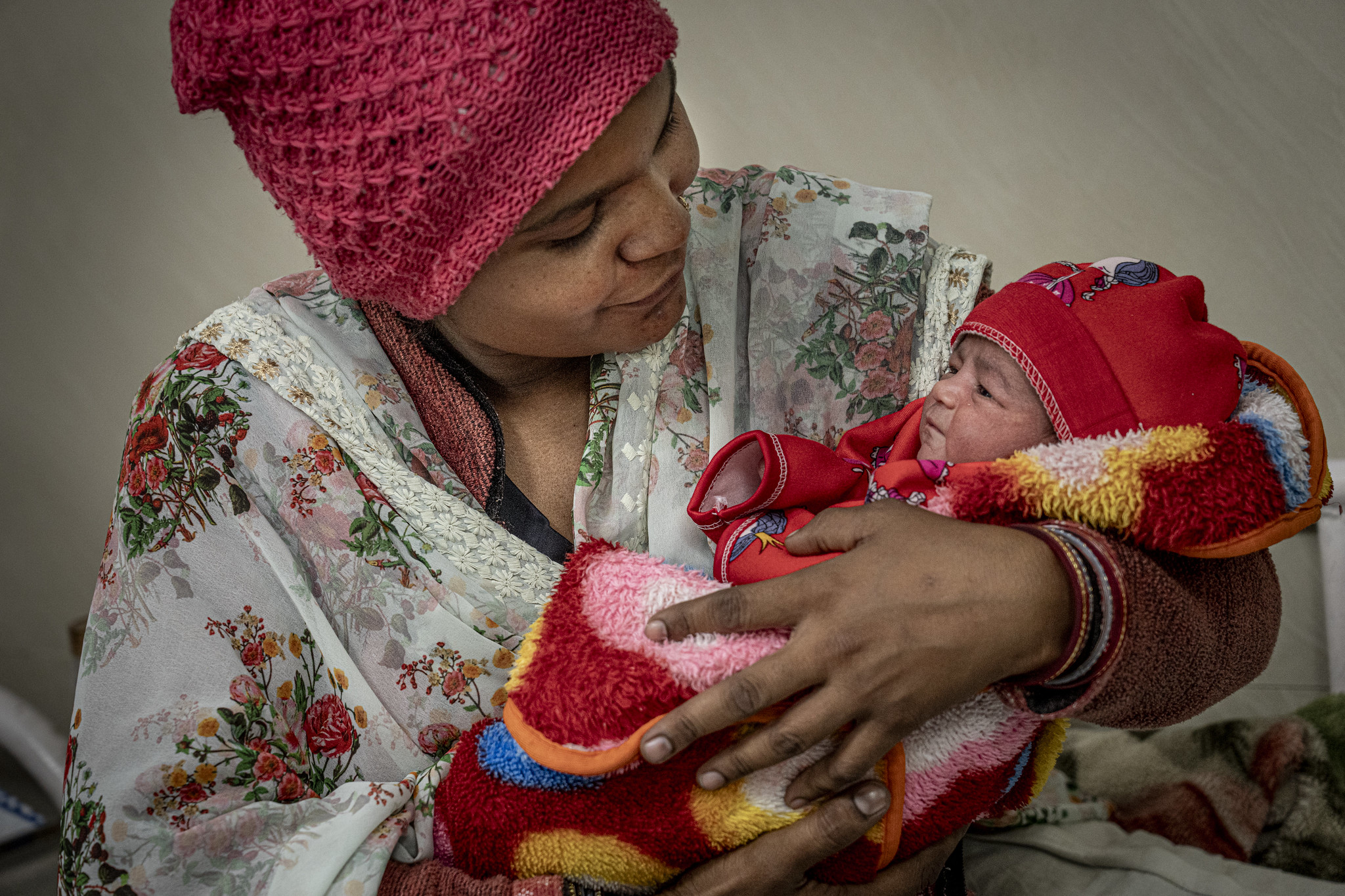
Women who are receiving treatment to prevent them contracting malaria while pregnant attend a sensitisation session that is supported by Jhpiego in Mbambamu Health Centre Kwango, Equatoria Democratic Republic of Congo Friday, Dec. 1, 2017. The Maternal and Child Survival Program, which is paid for by USAID is providing essential clinical training to maternity units and hospital in Kinshasa. ( Photo/KATE HOLT)

AMPLI-PPHI

Amplifying access to life-saving medicines and tools
to prevent and manage postpartum hemorrhage.

Did you know that postpartum hemorrhage (PPH) is the leading cause of maternal death worldwide? Fourteen million women experience postpartum hemorrhage annually. That’s 70,000 lives lost each year. The risk of PPH and PPH-related morbidity and mortality disproportionately affects women in low- and middle-income countries, especially those who lack access to quality care due to poverty, geography, and cultural barriers.

The Unitaid-funded Accelerating Measurable Progress and Leveraging Investments for Postpartum Hemorrhage Impact (AMPLI-PPHI) (pronounced “amplify”) project works with countries to accelerate short- and long-term action to prevent and treat PPH, focusing on three key areas: generating evidence and project learning, creating an enabling environment, and improving the market for the adoption of key lifesaving tools.

AMPLI-PPHI is a four-year (2022–2026), $26 million initiative with a goal to contribute to reduced maternal mortality from PPH by catalyzing the adoption of effective drugs and tools for PPH prevention, detection, and treatment as part of quality of intrapartum care. Jhpiego is leading AMPLI-PPHI in partnership with PATH and the International Federation of Gynecology and Obstetrics (FIGO), supporting countries to halt the detrimental effect of bleeding after birth. AMPLI-PPHI focuses on three key areas to achieve its goal and in partnership with countries: generating evidence and learning, creating an enabling environment, and improving the market to enable scale-up of four tools: heat-stable carbetocin (HSC) for prevention, calibrated drapes for detection, tranexamic acid (TXA) for treatment as part of a clinical care bundle, and misoprostol for prevention among women giving birth in the communities they live, in low- and middle-income countries. In partnership with governments from the Democratic Republic of Congo, Guinea, India, Kenya, Nigeria, and Zambia, and with complementary funding from the European Union through Safe Birth Africa, a joint Unitaid-UNFPA venture, and the Gates Foundation, AMPLI-PPHI supports countries to ensure that the right PPH tools are available and used at the right time for the right patient across health systems, ultimately reducing maternal morbidity and mortality.

Our Approaches

Generating Evidence and Project Learning

AMPLI-PPHI is generating evidence on the feasibility, acceptability, and costs of implementing newly recommended medicines, products, and delivery approaches across varying health settings.

  • By combining implementation research, routine monitoring, and process documentation, we are creating compelling evidence to support the adoption of World Health Organization (WHO) guidelines regarding these priority tools, as part of intrapartum care, to prevent, detect, and manage postpartum hemorrhage (PPH). This will also help shape future implementation guidance from the WHO. Additionally, AMPLI-PPHI is leveraging regional and global networks to share learnings with a wide range of scientific, practitioner, and policymaker audiences.

Creating an Enabling Environment

As countries introduce PPH medications, products, and delivery approaches at all levels of the health system, including the use of calibrated drapes for objective measurement of postpartum blood loss, AMPLI-PPHI will simultaneously support ministries of health to create enabling environments across the health system to effectively scale these PPH commodities.

  • We work with national program managers and key stakeholders to advocate for the key elements of implementation that are necessary for long-term success such as policies that support consistent availability of quality-assured PPH medicines at all appropriate levels of the health system, funding availability to support national scale-up, improved pharmacovigilance, dissemination of national guidelines to frontline providers, and improved awareness of PPH care at the community level.

  • Following successful advocacy efforts, we will conduct key steps to help build capacity:

    • Updating national policies, clinical guidelines, and resources to integrate PPH approaches and three key medicines: heat-stable carbetocin (HSC), tranexamic acid (TXA), and misoprostol.
    • Applying a “low-dose, high-frequency” training approach, whereby providers receive training onsite to incorporate the three medicines into clinical practice.
  • AMPLI-PPHI is coordinating and collaborating with key stakeholders at both global and country levels to build awareness and technical capacity on priority PPH medicines and to secure political and financial support around PPH, positioning countries for long-term success.

  • While AMPLI-PPHI is working directly in six target countries, the project also has identified 14 exchange countries, five additional states in India, and three additional states in Nigeria to help propel learning with evidence and tools that exchange countries and states could use to accelerate their PPH prevention and management efforts.

  • AMPLI-PPHI is supporting ministries of health to strengthen health systems so that quality-assured products are available to prevent and manage PPH. We are strengthening public procurement practices by developing guidance and convening workshops for government procurement and regulatory agencies on value-based procurement and price regulation mechanisms. We are also ensuring the correct use of the drugs by strengthening the capacity of health workers participating in the studies.

Preparing the Market

AMPLI-PPHI is ensuring long-term availability of quality-assured products beyond the life of the project.

  • As countries demonstrate the use of HSC and advanced distribution of misoprostol for PPH prevention and TXA for PPH treatment, demand for these medicines is expected to increase. However, current market conditions for HSC, misoprostol, and TXA can pose challenges to sustained availability of quality-assured products of these medications, whether due to the lack of registered products or high prices of quality-assured products.

  • To ensure long-term availability of high-quality products after the project concludes, AMPLI-PPHI is developing a business case that forecasts demand for three key PPH drugs, helping to outline the future potential of these markets. This includes conducting pricing surveys to determine fair price benchmarks for PPH drugs and providing technical support to manufacturers to ensure that these products remain affordable and accessible in low- and middle-income countries.

Program Experts

Elaine Roman

AMPLI-PPHI Project Director

Unitaid and Jhpiego advance lifesaving care for postpartum hemorrhage in resource-limited settings

Jhpiego will receive an additional US$2.3 million in funding to integrate the calibrated drape into existing programs in the Democratic Republic of Congo, Guinea and India, and support catalytic procurement in Rwanda.

“This project is uniquely positioned to bring catalytic change, connecting implementation learning with market shaping efforts. Through UNITAID’s commitment to expanding access to lifesaving drugs and our partnerships with ministries of health, FIGO, and PATH, we can prevent the deaths of thousands of women who experience severe bleeding after giving birth.”
— Elaine Roman, AMPLI-PPHI Director